

C++ API#
Fast code in skmap is written in C++ and exposed to Python with thin wrappers. This is a lower-level api. All Python-exposed functions handle setting up GDAL and then call a function on an array class.
Input-Output#
- group IO / Storage
Functions for reading/writing raster or matrix data to/from disk.
This group contains all I/O related functions, including GDAL-backed reading/writing and Python-friendly wrapper functions.
Functions
-
void readData(Eigen::Ref<MatFloat> data, const uint_t n_threads, const std::vector<std::string> &file_locs, const std::vector<uint_t> perm_vec, const uint_t x_off, const uint_t y_off, const uint_t x_size, const uint_t y_size, const std::vector<int> bands_list, py::dict conf_GDAL, std::optional<float_t> value_to_mask, std::optional<float_t> value_to_set)#
-
Currently only supports Float32 data
-
void writeData(Eigen::Ref<MatFloat> data, const uint_t n_threads, py::dict conf_GDAL, std::vector<std::string> base_files, std::string base_folder, std::vector<std::string> file_names, std::vector<uint_t> data_indices, uint_t x_off, uint_t y_off, uint_t x_size, uint_t y_size, float_t no_data_value, std::string gdal_data_type_str, std::optional<std::string> bash_compression_command, std::optional<std::vector<std::string>> seaweed_path)#
Python-friendly wrapper for writing raster data using GDAL and Eigen.
This function wraps the
IoArray::writeDatamethod, handling GDAL setup, nodata type dispatching, and optional post-processing (compression or remote storage).Other parameters are passed to
IoArray::WriteData: IoArray::WriteDataNote
For full details on the writing behavior, memory handling, and parallelization, see
IoArray::writeData: IoArray::writeData- Parameters:
data – Eigen::matrix reference containing the data to write.
n_threads – Number of threads for parallel I/O operations.
conf_GDAL – Python dictionary of GDAL configuration options.
-
void extractOverlay(Eigen::Ref<MatFloat> data, const uint_t n_threads, const std::vector<uint_t> pix_block_ids, const std::vector<uint_t> pix_inblock_idxs, const std::vector<uint_t> unique_blocks_ids_comb, const std::vector<uint_t> key_layer_ids_comb, Eigen::Ref<MatFloat> data_overlay)#
wrapper for
IoArray::extractOverlay
-
void warpTile(Eigen::Ref<MatFloat> data, const uint_t n_threads, py::dict conf_GDAL, std::string tile_path, std::string mosaic_path, std::string resample)#
wrapper for
IoArray::warpTile- Deprecated:
Please use gdal VRTs
-
void getLatLonArray(Eigen::Ref<MatFloat> data, const uint_t n_threads, py::dict conf_GDAL, std::string file_loc, uint_t x_off, uint_t y_off, uint_t x_size, uint_t y_size)#
-
void readData(std::vector<std::string> file_locs, std::vector<uint_t> perm_vec, uint_t x_off, uint_t y_off, uint_t x_size, uint_t y_size, GDALDataType read_type, std::vector<int> bands_list, std::optional<float_t> value_to_mask, std::optional<float_t> value_to_set)#
Reads multiple raster datasets into the internal matrix in parallel.
This function reads specified regions from a set of raster files (
file_locs) into the internalm_datamatrix, using a permutation vector to control the row order. Reading is performed in parallel via theparRowPermhelper, which callsreadDataCorefor each file.The function defines a lambda
readTiffthat wrapsreadDataCore, which reads a single raster into a given row buffer.parRowPermexecutes this lambda in parallel over the permutation vector, efficiently filling the internal matrixm_data.Note
Both
value_to_maskandvalue_to_setare forwarded toreadDataCorefor per-pixel masking and replacement.- Parameters:
file_locs – Vector of file paths or URLs of raster datasets to read.
perm_vec – Vector of row indices specifying the permutation order for writing into
m_data.x_off – Horizontal offset of the reading window in the rasters.
y_off – Vertical offset of the reading window in the rasters.
x_size – Width of the window to read.
y_size – Height of the window to read.
read_type – GDALDataType specifying the type to read (e.g., GDT_Float32).
bands_list – List of band indices to read from each dataset.
value_to_mask – Optional value to treat as masked (e.g., nodata). If not provided, no masking is performed.
value_to_set – Optional value to replace masked values with.
- Throws:
skmapAssertIfTrue – if the number of columns in
m_datais smaller than the requested reading window (x_size * y_size).
-
template<typename T>
inline void writeData(std::vector<std::string> base_files, std::string base_folder, std::vector<std::string> file_names, std::vector<uint_t> data_indices, uint_t x_off, uint_t y_off, uint_t x_size, uint_t y_size, GDALDataType write_type, T no_data_value, std::optional<std::string> bash_compression_command, std::optional<std::vector<std::string>> seaweed_path)# Write portions of the internal matrix
m_datato multiple GeoTIFF files.This function writes selected rows of the
m_datamatrix into GeoTIFF files based on a set of base files and offsets. It supports in-place row casting, NoData masking, optional bash compression commands, and optional uploading to a remote storage (e.g., SeaweedFS).For each row specified in
data_indices, the function:Opens the corresponding base file and copies geotransform, projection, and spatial reference.
Masks NaN values with
no_data_value.Writes the row to a temporary raster if compression is requested, otherwise directly to the final file.
Applies optional bash compression.
Uploads the file to
seaweed_pathif provided and removes local copies as needed.
- Template Parameters:
T – The data type to write to disk (e.g., float, double).
- Parameters:
base_files – Vector of file paths to base raster files to copy metadata from.
base_folder – Folder where output files will be written.
file_names – Names of the output files (without folder path).
data_indices – Indices of rows in
m_datacorresponding to each output file.x_off – X-offset within the raster to start writing data.
y_off – Y-offset within the raster to start writing data.
x_size – Width of the region to write.
y_size – Height of the region to write.
write_type – GDAL data type to write (e.g., GDT_Float32).
no_data_value – Value to use for missing or NaN cells.
bash_compression_command – Optional: shell command to compress the output files (e.g., gdal_translate or gzip).
seaweed_path – Optional: vector of remote storage paths to upload each output file.
-
void extractOverlay(std::vector<uint_t> pix_block_ids, std::vector<uint_t> pix_inblock_idxs, std::vector<uint_t> unique_blocks_ids_comb, std::vector<uint_t> key_layer_ids_comb, Eigen::Ref<MatFloat> data_overlay)#
Extract overlay values from raster blocks for a set of points.
For each pixel (given by
pix_block_idsandpix_inblock_idxs), this function finds the matching block and copies the corresponding raster values fromm_dataintodata_overlay.The operation is parallelized across pixels.
- Parameters:
pix_block_ids – Vector of block IDs corresponding to each pixel.
pix_inblock_idxs – Vector of linear indices of each pixel within its block.
unique_blocks_ids_comb – Vector of all unique block IDs for the current chunk.
key_layer_ids_comb – Vector of layer indices corresponding to each block-layer combination.
data_overlay – Output array (layers x pixels) where extracted values will be stored.
-
void warpTile(std::string ref_tile_path, std::string mosaic_path, std::string resample)#
Warp a single-band mosaic to match a reference tile.
- Deprecated:
This function is deprecated. Use GDAL VRTs instead, which provide on-the-fly mosaicking and warping, support multiple bands, and avoid loading full rasters into memory.
This function opens the reference tile and mosaic, computes the target dimensions, sets up GDALWarpOptions, and performs an in-memory warp to match the reference. The resulting raster is read into
m_data.Note
Only works for single-band float32 rasters.
- Parameters:
ref_tile_path – File path to reference raster tile.
mosaic_path – File path to mosaic raster.
resample – Resampling method (“nearest”, “bilinear”, etc.)
-
void readData(Eigen::Ref<MatFloat> data, const uint_t n_threads, const std::vector<std::string> &file_locs, const std::vector<uint_t> perm_vec, const uint_t x_off, const uint_t y_off, const uint_t x_size, const uint_t y_size, const std::vector<int> bands_list, py::dict conf_GDAL, std::optional<float_t> value_to_mask, std::optional<float_t> value_to_set)#
Data mangling#
- group Data mangling
Functions for changing the shape of data for efficient parallel processing
For canonical usage examples, see unit tests
Functions
-
void copyVecInMatrixRow(Eigen::Ref<MatFloat> data, const uint_t n_threads, Eigen::Ref<VecFloat> in_vec, uint_t row_idx)#
-
void selArrayRows(Eigen::Ref<MatFloat> data, const uint_t n_threads, Eigen::Ref<MatFloat> out_data, std::vector<uint_t> row_select)#
-
void selArrayCols(Eigen::Ref<MatFloat> data, const uint_t n_threads, Eigen::Ref<MatFloat> out_data, std::vector<uint_t> col_select)#
-
void expandArrayRows(Eigen::Ref<MatFloat> data, const uint_t n_threads, Eigen::Ref<MatFloat> out_data, std::vector<uint_t> row_select)#
-
void expandArrayCols(Eigen::Ref<MatFloat> data, const uint_t n_threads, Eigen::Ref<MatFloat> out_data, std::vector<uint_t> col_select)#
-
void reorderArray(Eigen::Ref<MatFloat> data, const uint_t n_threads, Eigen::Ref<MatFloat> out_data, std::vector<std::vector<uint_t>> indices_matrix)#
-
void transposeArray(Eigen::Ref<MatFloat> data, const uint_t n_threads, Eigen::Ref<MatFloat> out_data)#
simple transpose, see
TransArray::transposeArrayfor details
-
void transposeReorderArray(Eigen::Ref<MatFloat> data, const uint_t n_threads, Eigen::Ref<MatFloat> out_data, std::vector<std::vector<uint_t>> permutation_matrix)#
-
void inverseReorderArray(Eigen::Ref<MatFloat> data, const uint_t n_threads, Eigen::Ref<MatFloat> out_data, std::vector<std::vector<uint_t>> indices_matrix)#
-
void copyVecInMatrixRow(Eigen::Ref<VecFloat> in_vec, uint_t row_idx)#
Copy a vector into the matrix.
If you created a vector in Python, this is the way to add it to the matrix
- Parameters:
in_vec – Vector to copy
row_idx – Matrix row to copy into
-
void selArrayRows(Eigen::Ref<MatFloat> out_data, std::vector<uint_t> row_select)#
Select
row_selectrows to put inout_datain-order.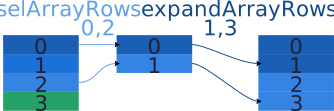
out_data.rows()MUST be>=row_select.len()andout_data.cols()MUST match the width.- Parameters:
out_data – output matrix
row_select – rows to select from initial matrix
-
void selArrayCols(Eigen::Ref<MatFloat> out_data, std::vector<uint_t> col_select)#
Select
col_selectcols to put inout_datain-order.out_data.cols()MUST be>=row_select.len()andout_data.rows()MUST match the height.- Parameters:
out_data – output matrix
col_select – columns to select from initial matrix
-
void expandArrayRows(Eigen::Ref<MatFloat> out_data, std::vector<uint_t> row_select)#
Inserts rows of self into
out_dataatrow_selectindices.length of
row_selectMUST equalm_data.rows()- Parameters:
out_data – Output array
row_select – indices at which to put
m_data
-
void expandArrayCols(Eigen::Ref<MatFloat> out_data, std::vector<uint_t> col_select)#
Inserts columns of self into
out_dataatcol_selectindices.length of
col_selectMUST equalm_data.cols()- Parameters:
out_data – Output array
col_select – indices at which to put
m_data
-
void reorderArray(Eigen::Ref<MatFloat> out_data, std::vector<std::vector<uint_t>> indices_matrix)#
Expands the indices of
indices_matrixto get a wider matrix.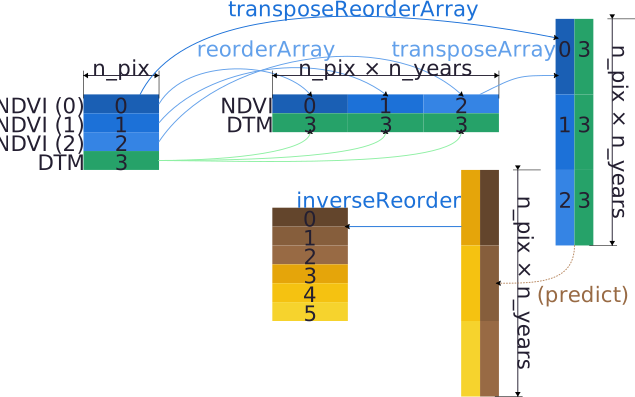
This function is almost always slower than
transposeReorderArray- Parameters:
out_data – The wider output matrix
indices_matrix – a rectangular matrix of indices to expand
-
void transposeArray(Eigen::Ref<MatFloat> out_data)#
Transposes the array.
Transposes the array
- Parameters:
out_data – Array to be filled with transposed values
-
void transposeReorderArray(Eigen::Ref<MatFloat> out_data, std::vector<std::vector<uint_t>> permutation_matrix)#
reorders and transposes in one step
Warning
Currently not working as intended
- Parameters:
out_data – output data matrix
permutation_matrix – permutation matrix
-
void inverseReorderArray(Eigen::Ref<MatFloat> out_data, std::vector<std::vector<uint_t>> indices_matrix)#
Inverse of
TransArray::reorderArraySelects blocks from the array based on
out_datawidth andindices_matrix- Parameters:
out_data – Narrower output matrix
indices_matrix – matrix of indices to be appended
-
void copyVecInMatrixRow(Eigen::Ref<MatFloat> data, const uint_t n_threads, Eigen::Ref<VecFloat> in_vec, uint_t row_idx)#
Data manipulation#
- group Data manipulation
parallel operations on data arrays
Functions
-
void fillArray(Eigen::Ref<MatFloat> data, const uint_t n_threads, float_t val)#
-
void maskNan(Eigen::Ref<MatFloat> data, const uint_t n_threads, std::vector<uint_t> row_select, float_t new_value_in_data)#
-
void maskNanRows(Eigen::Ref<MatFloat> data, const uint_t n_threads, std::vector<uint_t> row_select, Eigen::Ref<VecFloat> new_value_vec)#
-
void maskData(Eigen::Ref<MatFloat> data, const uint_t n_threads, std::vector<uint_t> row_select, Eigen::Ref<MatFloat> mask, float_t value_of_mask_to_mask, float_t new_value_in_data)#
-
void maskDataRows(Eigen::Ref<MatFloat> data, const uint_t n_threads, std::vector<uint_t> row_select, Eigen::Ref<MatFloat> mask, float_t value_of_mask_to_mask, float_t new_value_in_data)#
-
void swapRowsValues(Eigen::Ref<MatFloat> data, const uint_t n_threads, std::vector<uint_t> row_select, float_t value_to_mask, float_t new_value)#
-
void hadamardProduct(Eigen::Ref<MatFloat> out, const uint_t n_threads, Eigen::Ref<MatFloat> in1, Eigen::Ref<MatFloat> in2)#
-
void offsetAndScale(Eigen::Ref<MatFloat> data, const uint_t n_threads, float_t offset, float_t scaling)#
-
void scaleAndOffset(Eigen::Ref<MatFloat> data, const uint_t n_threads, float_t offset, float_t scaling)#
-
void offsetsAndScales(Eigen::Ref<MatFloat> data, const uint_t n_threads, std::vector<uint_t> row_select, Eigen::Ref<VecFloat> offsets, Eigen::Ref<VecFloat> scalings)#
-
void castFloat32ToFloat64(Eigen::Ref<Eigen::Matrix<float, Eigen::Dynamic, Eigen::Dynamic, Eigen::RowMajor>> data, const uint_t n_threads, Eigen::Ref<Eigen::Matrix<double, Eigen::Dynamic, Eigen::Dynamic, Eigen::RowMajor>> out_data)#
Cast a
floatarray to adoublearray.Will error on a size mismatch
- Parameters:
data – Input data
n_threads – number of threads to use
out_data – output array
-
void castFloat64ToFloat32(Eigen::Ref<Eigen::Matrix<double, Eigen::Dynamic, Eigen::Dynamic, Eigen::RowMajor>> data, const uint_t n_threads, Eigen::Ref<Eigen::Matrix<float, Eigen::Dynamic, Eigen::Dynamic, Eigen::RowMajor>> out_data)#
Cast a
doublearray to afloatarray.Will error on a size mismatch
- Parameters:
data – Input data
n_threads – number of threads to use
out_data – output array
-
void fillArray(float_t val)#
Fill array with
val- Parameters:
val – The fill value
-
void maskNan(std::vector<uint_t> row_select, float_t new_value_in_data)#
Fill
NANs inrow_selectwithnew_value_in_dataIf the fill value should be different per row, see
TransArray::maskNanRows- Parameters:
row_select – vec of row indices to mask
new_value_in_data – mask value
-
void maskNanRows(std::vector<uint_t> row_select, Eigen::Ref<VecFloat> new_value_vec)#
Fill
NANs inrow_selectwith corresponding value innew_value_vecThe fill value will correspond to the index in
row_select- Parameters:
row_select – vec of row indices to mask
new_value_vec – mask values per index
-
void maskData(std::vector<uint_t> row_select, Eigen::Ref<MatFloat> masks, float_t value_of_mask_to_mask, float_t new_value_in_data)#
fills data with
new_value_in_datawheremask==value_of_mask_to_maskThe mask row corresponds to the index of
row_select. For using the same mask for all rows, seeTransArray::maskDataRows.Warning
maskDataRowsandmaskDatamay swap names- Parameters:
row_select – vec of rows to apply masks to
masks – masks, one for each row
value_of_mask_to_mask – if the mask cell equals this value, overwrite data
new_value_in_data – the value to overwrite data with
-
void maskDataRows(std::vector<uint_t> row_select, Eigen::Ref<MatFloat> mask, float_t value_of_mask_to_mask, float_t new_value_in_data)#
fills data with
new_value_in_datawheremask==value_of_mask_to_maskThis function applies the same mask to all rows. To apply a different mask per row, see
TransArray::maskDataWarning
maskDataRowsandmaskDatamay swap names- Parameters:
row_select – vec of rows to apply masks to
mask – mask for all rows
value_of_mask_to_mask – if the mask cell equals this value, overwrite data
new_value_in_data – the value to overwrite data with
-
void swapRowsValues(std::vector<uint_t> row_select, float_t value_to_mask, float_t new_value)#
swap
value_to_maskwithnew_valueinrow_selectrowsWarning
This may be renamed to
swapValues- Parameters:
row_select – vec of rows to swap values on
value_to_mask – value to filter out (noData value?)
new_value – fill value
-
void hadamardProduct(Eigen::Ref<MatFloat> in1, Eigen::Ref<MatFloat> in2)#
element-wise product of two matrices
will fill this array with the result. Therefore,
in1,in2and this array’s dimensions MUST match exactly.- Parameters:
in1, in2 – The two matrices to multiply element-wise
-
void offsetAndScale(float_t offset, float_t scaling)#
Applies offset and scale to all rows.
v_new = (v_old+offset)*scaling
- Parameters:
offset – Offset to apply
scaling – Scale factor
-
void scaleAndOffset(float_t offset, float_t scaling)#
Applies scale and offset to all rows.
v_new = v_old*scaling+offset
- Parameters:
offset – Offset to add
scaling – Scale factor
-
void offsetsAndScales(std::vector<uint_t> row_select, Eigen::Ref<VecFloat> offsets, Eigen::Ref<VecFloat> scalings)#
Applies multiple offsets and scales.
v_new = (v_old+offset)*scaling
Warning
UNSTABLE Currently index of offsets and scalings is the same as in
m_data. This may be updated so that it is the same as row_select.- Parameters:
row_select – permutation matrix with rows to select
offsets – Offsets to apply.
scalings – Scale factors
-
void fillArray(Eigen::Ref<MatFloat> data, const uint_t n_threads, float_t val)#
Data Processing#
- group Data processing
data processing and statistics
Functions
-
void nanMean(Eigen::Ref<MatFloat> data, const uint_t n_threads, Eigen::Ref<VecFloat> out_data)#
-
void blocksAverage(Eigen::Ref<MatFloat> out, const uint_t n_threads, Eigen::Ref<MatFloat> in1, Eigen::Ref<MatFloat> in2, uint_t n_pix, uint_t y)#
see
TransArray::blocksAverage
-
void blocksAverageVecs(Eigen::Ref<MatFloat> out, const uint_t n_threads, Eigen::Ref<MatFloat> in1, Eigen::Ref<MatFloat> in2, uint_t n_pix, uint_t y, uint_t row_offset)#
-
void elementwiseAverage(Eigen::Ref<MatFloat> out, const uint_t n_threads, Eigen::Ref<MatFloat> in1, Eigen::Ref<MatFloat> in2)#
-
void extractIndicators(Eigen::Ref<MatFloat> data_in, const uint_t n_threads, Eigen::Ref<MatFloat> data_out, uint_t col_in_select, std::vector<uint_t> col_out_select, std::vector<uint_t> classes)#
-
void fitPercentage(Eigen::Ref<MatFloat> out, const uint_t n_threads, Eigen::Ref<MatFloat> in1, Eigen::Ref<MatFloat> in2)#
-
void texturesBwTransform(Eigen::Ref<MatFloat> texture_1, const uint_t n_threads, Eigen::Ref<MatFloat> texture_2, float_t k, float_t a, Eigen::Ref<MatFloat> sand, Eigen::Ref<MatFloat> silt, Eigen::Ref<MatFloat> clay)#
-
void linearRegression(Eigen::Ref<MatFloat> data, const uint_t n_threads, Eigen::Ref<VecFloat> x, Eigen::Ref<VecFloat> beta_0, Eigen::Ref<VecFloat> beta_1)#
-
void computeMannKendallPValues(Eigen::Ref<MatFloat> data, const uint_t n_threads, Eigen::Ref<VecFloat> out_data)#
-
void averageAggregate(Eigen::Ref<MatFloat> data, const uint_t n_threads, Eigen::Ref<MatFloat> out_data, uint_t agg_factor)#
-
void maskDifference(Eigen::Ref<MatFloat> data, const uint_t n_threads, float_t diff_th, uint_t count_th, Eigen::Ref<MatFloat> ref_data, Eigen::Ref<MatFloat> mask_out)#
-
void computeNormalizedDifference(Eigen::Ref<MatFloat> data, const uint_t n_threads, std::vector<uint_t> positive_indices, std::vector<uint_t> negative_indices, std::vector<uint_t> result_indices, float_t positive_scaling, float_t negative_scaling, float_t result_scaling, float_t result_offset, std::vector<float_t> clip_value)#
-
void computeNirv(Eigen::Ref<MatFloat> data, const uint_t n_threads, std::vector<uint_t> nir_indices, std::vector<uint_t> red_indices, std::vector<uint_t> result_indices, float_t nir_scaling, float_t red_scaling, float_t result_scaling, float_t result_offset, std::vector<float_t> clip_value)#
-
void computeBsi(Eigen::Ref<MatFloat> data, const uint_t n_threads, std::vector<uint_t> swir1_indices, std::vector<uint_t> red_indices, std::vector<uint_t> nir_indices, std::vector<uint_t> blue_indices, std::vector<uint_t> result_indices, float_t swir1_scaling, float_t red_scaling, float_t nir_scaling, float_t blue_scaling, float_t result_scaling, float_t result_offset, std::vector<float_t> clip_value)#
-
void computeEvi(Eigen::Ref<MatFloat> data, const uint_t n_threads, std::vector<uint_t> red_indices, std::vector<uint_t> nir_indices, std::vector<uint_t> blue_indices, std::vector<uint_t> result_indices, float_t red_scaling, float_t nir_scaling, float_t blue_scaling, float_t result_scaling, float_t result_offset, std::vector<float_t> clip_value)#
-
void computeFapar(Eigen::Ref<MatFloat> data, const uint_t n_threads, std::vector<uint_t> red_indices, std::vector<uint_t> nir_indices, std::vector<uint_t> result_indices, float_t red_scaling, float_t nir_scaling, float_t result_scaling, float_t result_offset, std::vector<float_t> clip_value)#
-
void computeSavi(Eigen::Ref<MatFloat> data, const uint_t n_threads, std::vector<uint_t> red_indices, std::vector<uint_t> nir_indices, std::vector<uint_t> result_indices, float_t red_scaling, float_t nir_scaling, float_t result_scaling, float_t result_offset, std::vector<float_t> clip_value)#
-
void computeGeometricTemperature(Eigen::Ref<MatFloat> data, const uint_t n_threads, Eigen::Ref<MatFloat> latitude, Eigen::Ref<MatFloat> elevation, float_t elevation_scaling, float_t a, float_t b, float_t result_scaling, std::vector<uint_t> result_indices, std::vector<float_t> days_of_year)#
-
void computePercentiles(Eigen::Ref<MatFloat> data, const uint_t n_threads, std::vector<uint_t> col_in_select, Eigen::Ref<MatFloat> out_data, std::vector<uint_t> col_out_select, std::vector<float_t> percentiles)#
-
void fitProbabilities(Eigen::Ref<MatFloat> data, const uint_t n_threads, Eigen::Ref<MatFloat> out_data, float_t input_scaling, uint_t target_scaling, Eigen::Ref<MatFloat> best_classes_data, uint_t n_best_classes)#
-
void applyTsirf(Eigen::Ref<MatFloat> data, const uint_t n_threads, Eigen::Ref<MatFloat> out_data, uint_t out_index_offset, float_t w_0, Eigen::Ref<VecFloat> w_p, Eigen::Ref<VecFloat> w_f, bool keep_original_values, const std::string &version, const std::string &backend)#
-
void nanMeanAggregatePattern(Eigen::Ref<MatFloat> data, const uint_t n_threads, Eigen::Ref<MatFloat> out_data, std::vector<std::vector<uint_t>> &agg_pattern)#
-
void convolveRows(Eigen::Ref<MatFloat> data, const uint_t n_threads, Eigen::Ref<MatFloat> out_data, float_t w_0, Eigen::Ref<VecFloat> w_p, Eigen::Ref<VecFloat> w_f)#
-
void slidingWindowClassMode(Eigen::Ref<MatFloat> data, const uint_t n_threads, Eigen::Ref<MatFloat> out_data, size_t window_size)#
-
void nanMean(Eigen::Ref<VecFloat> out_data)#
Computes the per-row mean of non-Nan values.
Processes chunks in parallel
- Parameters:
out_data – Vec of rows length
-
void elementwiseAverage(Eigen::Ref<MatFloat> in1, Eigen::Ref<MatFloat> in2)#
Fills this array with the element-wise average of
in1andin2- Parameters:
in1 – The first matrix
in2 – The second matrix
-
void computePercentiles(std::vector<uint_t> col_in_select, Eigen::Ref<MatFloat> out_data, std::vector<uint_t> col_out_select, std::vector<float_t> percentiles)#
Computes per-pixel percentiles across layers.
This works on transposed data where layers are columns and rows are pixels
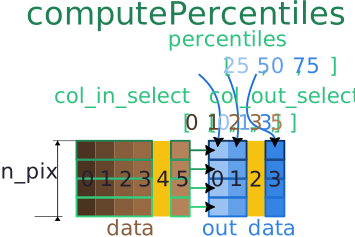
- Parameters:
col_in_select – The columns to use for computing percentiles
out_data – Output array, should have
n_pixrowscol_out_select – columns in Output array to fill
percentiles – List of percentiles
[0-100]
-
void nanMean(Eigen::Ref<MatFloat> data, const uint_t n_threads, Eigen::Ref<VecFloat> out_data)#
IoArray Class#
This class is used by TiledDataLoader, TiledDataExporter and SpaceOverlay
-
class IoArray : public skmap::ParArray#
Public Functions
-
void readDataCore(Eigen::Ref<MatFloat::RowXpr> row, std::string file_loc, uint_t x_off, uint_t y_off, uint_t x_size, uint_t y_size, GDALDataType read_type, int band, std::optional<float_t> value_to_mask, std::optional<float_t> value_to_set)#
Reads a portion of a raster dataset into a row buffer.
This function opens a raster dataset using GDAL, reads a rectangular window defined by offsets and sizes into an Eigen row expression, and optionally replaces a specific masked value with another value.
Opens the GDAL dataset in read-only mode, reads the specified rectangular portion into the provided Eigen row buffer, and closes the dataset. If both
value_to_maskandvalue_to_setare provided and are different, the function replaces all occurrences ofvalue_to_maskin the buffer withvalue_to_set.Note
If only
value_to_setis provided, the function automatically determines the dataset’s nodata value to use asvalue_to_mask.- Parameters:
row – Reference to an Eigen row expression where the data will be stored.
file_loc – File path or URL of the raster dataset to read.
x_off – Horizontal offset of the window to read.
y_off – Vertical offset of the window to read.
x_size – Width of the window to read.
y_size – Height of the window to read.
read_type – GDAL data type to read (e.g., GDT_Float32).
bands_list – List of band indices to read from the dataset.
value_to_mask – Optional value in the dataset to treat as “masked” (e.g., nodata).
value_to_set – Optional value to replace the masked values with.
- Throws:
skmapAssertIfTrue – if the dataset cannot be opened or read.
-
void setupGdal(dict_t dict)#
Initialize GDAL with custom configuration options and error handling.
Sets GDAL runtime options from the input dictionary, registers all GDAL drivers, and configures error logging to suppress console output if possible.
Each key-value pair in
dictis applied via CPLSetConfigOption(). GDALAllRegister() is called to ensure all drivers are available. Error logging is redirected to “/dev/null” if possible; otherwise, a quiet error handler is used to suppress warnings and errors.Note
This function modifies global GDAL state and should be called before performing any GDAL I/O operations. All Python-exposed functions call it already.
- Parameters:
dict – Dictionary of GDAL configuration options (key-value pairs) where keys and values are strings recognized by GDAL.
-
void readDataCore(Eigen::Ref<MatFloat::RowXpr> row, std::string file_loc, uint_t x_off, uint_t y_off, uint_t x_size, uint_t y_size, GDALDataType read_type, int band, std::optional<float_t> value_to_mask, std::optional<float_t> value_to_set)#
TransArray Class#
-
class TransArray : public skmap::ParArray#
Public Functions
-
TransArray(Eigen::Ref<MatFloat> data, const uint_t n_threads)#
-
void linearRegression(Eigen::Ref<VecFloat> x, Eigen::Ref<VecFloat> beta_0, Eigen::Ref<VecFloat> beta_1)#
-
void averageAggregate(Eigen::Ref<MatFloat> out_data, uint_t agg_factor)#
-
void maskDifference(float_t diff_th, uint_t count_th, Eigen::Ref<MatFloat> ref_data, Eigen::Ref<MatFloat> mask_out)#
-
void fitPercentage(Eigen::Ref<MatFloat> in1, Eigen::Ref<MatFloat> in2)#
-
void computeMannKendallPValues(Eigen::Ref<VecFloat> out_data)#
-
void blocksAverage(Eigen::Ref<MatFloat> in1, Eigen::Ref<MatFloat> in2, uint_t n_pix, uint_t y)#
-
void blocksAverageVecs(Eigen::Ref<MatFloat> in1, Eigen::Ref<MatFloat> in2, uint_t n_pix, uint_t y, uint_t row_offset)#
-
void texturesBwTransform(Eigen::Ref<MatFloat> texture_2, float_t k, float_t a, Eigen::Ref<MatFloat> sand, Eigen::Ref<MatFloat> silt, Eigen::Ref<MatFloat> clay)#
-
void slidingWindowClassMode(Eigen::Ref<MatFloat> out_data, size_t window_size)#
-
void computeNormalizedDifference(std::vector<uint_t> positive_indices, std::vector<uint_t> negative_indices, std::vector<uint_t> result_indices, float_t positive_scaling, float_t negative_scaling, float_t result_scaling, float_t result_offset, std::vector<float_t> clip_value)#
-
void computeBsi(std::vector<uint_t> swir1_indices, std::vector<uint_t> red_indices, std::vector<uint_t> nir_indices, std::vector<uint_t> blue_indices, std::vector<uint_t> result_indices, float_t swir1_scaling, float_t red_scaling, float_t nir_scaling, float_t blue_scaling, float_t result_scaling, float_t result_offset, std::vector<float_t> clip_value)#
-
void computeEvi(std::vector<uint_t> red_indices, std::vector<uint_t> nir_indices, std::vector<uint_t> blue_indices, std::vector<uint_t> result_indices, float_t red_scaling, float_t nir_scaling, float_t blue_scaling, float_t result_scaling, float_t result_offset, std::vector<float_t> clip_value)#
-
void computeNirv(std::vector<uint_t> nir_indices, std::vector<uint_t> red_indices, std::vector<uint_t> result_indices, float_t nir_scaling, float_t red_scaling, float_t result_scaling, float_t result_offset, std::vector<float_t> clip_value)#
-
void computeFapar(std::vector<uint_t> red_indices, std::vector<uint_t> nir_indices, std::vector<uint_t> result_indices, float_t red_scaling, float_t nir_scaling, float_t result_scaling, float_t result_offset, std::vector<float_t> clip_value)#
-
void computeSavi(std::vector<uint_t> red_indices, std::vector<uint_t> nir_indices, std::vector<uint_t> result_indices, float_t red_scaling, float_t nir_scaling, float_t result_scaling, float_t result_offset, std::vector<float_t> clip_value)#
-
void computeGeometricTemperature(Eigen::Ref<MatFloat> latitude, Eigen::Ref<MatFloat> elevation, float_t elevation_scaling, float_t a, float_t b, float_t result_scaling, std::vector<uint_t> result_indices, std::vector<float_t> days_of_year)#
-
void fitProbabilities(Eigen::Ref<MatFloat> out_data, float_t input_scaling, uint_t target_scaling, Eigen::Ref<MatFloat> best_classes_data, uint_t n_best_classes)#
-
void applyTsirf(Eigen::Ref<MatFloat> out_data, uint_t out_index_offset, float_t w_0, Eigen::Ref<VecFloat> w_p, Eigen::Ref<VecFloat> w_f, bool keep_original_values, const std::string &version, const std::string &backend)#
-
void convolveRows(Eigen::Ref<MatFloat> out_data, float_t w_0, Eigen::Ref<VecFloat> w_p, Eigen::Ref<VecFloat> w_f)#
-
void extractIndicators(Eigen::Ref<MatFloat> data_out, uint_t col_in_select, std::vector<uint_t> col_out_select, std::vector<uint_t> classes)#
-
void nanMeanAggregatePattern(Eigen::Ref<MatFloat> out_data, std::vector<std::vector<uint_t>> &agg_pattern)#
-
TransArray(Eigen::Ref<MatFloat> data, const uint_t n_threads)#
ParArray Class#
-
class ParArray#
Subclassed by skmap::IoArray, skmap::TransArray
Public Functions
-
ParArray(Eigen::Ref<MatFloat> data, const uint_t n_threads)#
-
void printData()#
-
template<typename F>
inline void parRowPerm(F f_in, std::vector<uint_t> perm_vec)# process
f_inparallelly on rows, based on the order inperm_vecperm_vec is allowed to be any length less than
rows().Warning
If an index appears twice, this will cause a data race
- Parameters:
f_in – The function to apply to each row
perm_vec – vector with row indices
-
ParArray(Eigen::Ref<MatFloat> data, const uint_t n_threads)#
Bindings#
Functions
-
GDALDataType GetGDALDataTypeFromString(const std::string &gdal_data_type_str)#
-
std::optional<NodataVariant> getNodataVariant(const std::string &gdal_data_type_str, float_t no_data_value)#
-
dict_t convPyDict(py::dict in_dict)#
-
map_t convPyMap(py::dict in_map)#
-
void readDataBlocks(Eigen::Ref<MatFloat> data, const uint_t n_threads, const std::vector<std::string> &file_locs, const std::vector<uint_t> perm_vec, const std::vector<uint_t> x_off_vec, const std::vector<uint_t> y_off_vec, const std::vector<uint_t> x_size_vec, const std::vector<uint_t> y_size_vec, const std::vector<int> bands_list, py::dict conf_GDAL, std::optional<std::vector<float_t>> value_to_mask_vec, std::optional<float_t> value_to_set)#
-
void readDataCore(Eigen::Ref<MatFloat> data, const uint_t n_threads, const std::string file_loc, const uint_t x_off, const uint_t y_off, const uint_t x_size, const uint_t y_size, int band, py::dict conf_GDAL, std::optional<float_t> value_to_mask, std::optional<float_t> value_to_set)#
core implementation, see
IoArray::readDataCore
-
void writeInt16Data(Eigen::Ref<MatFloat> data, const uint_t n_threads, py::dict conf_GDAL, std::vector<std::string> base_files, std::string base_folder, std::vector<std::string> file_names, std::vector<uint_t> data_indices, uint_t x_off, uint_t y_off, uint_t x_size, uint_t y_size, int16_t no_data_value, std::optional<std::string> bash_compression_command, std::optional<std::vector<std::string>> seaweed_path)#
- Deprecated:
-
void writeUInt16Data(Eigen::Ref<MatFloat> data, const uint_t n_threads, py::dict conf_GDAL, std::vector<std::string> base_files, std::string base_folder, std::vector<std::string> file_names, std::vector<uint_t> data_indices, uint_t x_off, uint_t y_off, uint_t x_size, uint_t y_size, uint16_t no_data_value, std::optional<std::string> bash_compression_command, std::optional<std::vector<std::string>> seaweed_path)#
- Deprecated:
-
void writeByteData(Eigen::Ref<MatFloat> data, const uint_t n_threads, py::dict conf_GDAL, std::vector<std::string> base_files, std::string base_folder, std::vector<std::string> file_names, std::vector<uint_t> data_indices, uint_t x_off, uint_t y_off, uint_t x_size, uint_t y_size, byte_t no_data_value, std::optional<std::string> bash_compression_command, std::optional<std::vector<std::string>> seaweed_path)#
- Deprecated:
-
void extractArrayRows(Eigen::Ref<MatFloat> data, const uint_t n_threads, Eigen::Ref<MatFloat> out_data, std::vector<uint_t> row_select)#
- Deprecated:
use selArrayRows in stead
-
void extractArrayCols(Eigen::Ref<MatFloat> data, const uint_t n_threads, Eigen::Ref<MatFloat> out_data, std::vector<uint_t> col_select)#
- Deprecated:
use selArrayCols in stead
-
void checkSimdInstructionSetsInUse()#
-
PYBIND11_MODULE(skmap_bindings, m)#